विशेष लेख
The Most Impressive Water Lilies Paintings
When Impressionism first appeared, it was met with harsh criticism from traditional art circles. Yet it became the first truly modern artistic movement because it rejected established rules of representation and conventional painting techniques. The movement also introduced new ideas about the artist’s lifestyle, creative process, and relationship with the world—elements that became inseparable from artistic practice itself.
Sage Hollow
लेखक
लेख परिचय
नीचे पूरा लेख पढ़ें।
अनुभाग
समाचार
When Impressionism first appeared, it was met with harsh criticism from traditional art circles. Yet it became the first truly modern artistic movement because it rejected established rules of representation and conventional painting techniques. The movement also introduced new ideas about the artist’s lifestyle, creative process, and relationship with the world—elements that became inseparable from artistic practice itself.
At the forefront of this groundbreaking movement stood Claude Monet. He championed the study of light, atmospheric changes, and unconventional viewpoints, expressing these ideas through outdoor landscape painting. His innovative approach reached a milestone in the 1870s with Impression, Sunrise, the painting that ultimately gave Impressionism its name. However, the body of work that secured his lasting legacy was not a single canvas but a monumental series he developed over three decades: the celebrated Water Lilies.
Giverny: Monet’s Artistic Paradise
In 1883, Monet moved with his family to a large property in Giverny, located between Vernon and Gasny. The estate included orchards, a modest garden, and a spacious barn that was converted into a studio.
As Monet’s reputation grew and his paintings began selling successfully, he purchased the property in 1890, including the surrounding land. That same year, a greenhouse and a skylit studio were added to support both his gardening and artistic pursuits.
His passion for horticulture deepened further in 1893 when he acquired additional land containing a pond. This area would become the famous water garden. Working alongside several gardeners, Monet redirected a nearby stream, introduced water lilies, and planted bamboo, weeping willows, and various exotic flowers. The resulting landscape resembled a dreamlike painting brought to life and reflected his ambition to transform nature into a living work of art.
Monet began painting the pond in 1899. Early compositions featured the Japanese bridge viewed vertically, while later works expanded into larger formats. Over his lifetime, he produced more than two hundred paintings inspired by the water garden.
The Famous Water Lilies Series
The first Water Lilies exhibition, consisting of twenty-five canvases, was presented in 1900 at Galerie Durand-Ruel in Paris. Nine years later, Monet completed a second group containing forty-eight paintings.
During the 1920s, the French government commissioned two oval galleries at the Musée de l’Orangerie to permanently house eight monumental water lily murals. Although the installation was completed shortly after Monet’s death, the museum opened in 1927. Decades later, in 1999, the same institution reunited sixty paintings from the series for a special exhibition.
Today, works from the Water Lilies collection are dispersed among major museums worldwide, including the Musée d’Orsay, the Metropolitan Museum of Art, the Museum of Modern Art in New York, the Saint Louis Art Museum, the Carnegie Museum of Art, the National Museum of Wales, and the Musée des Beaux-Arts de Nantes.
The series ultimately expanded the possibilities of modern art and anticipated many developments in abstraction. More than any other works by Monet, the Water Lilies profoundly influenced twentieth-century painting.
Monet’s Garden as Inspiration
Late in life, Monet devoted enormous attention to his beloved gardens at Giverny. Inspired partly by Japanese water gardens, he created an environment filled with poppies, irises, blue sage, dahlias, bamboo, and floating lilies.
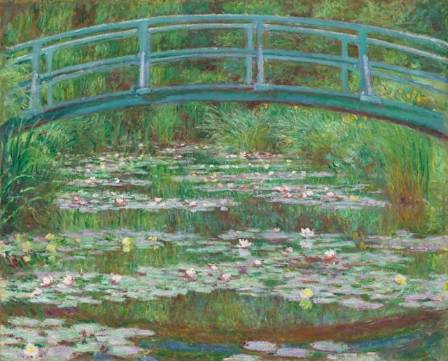
The pond, fed by the Ru River, was bordered by silver birches and graceful weeping willows. A distinctive green Japanese-style bridge crossed the water and became one of the most recognizable elements in his paintings.
Monet once remarked:“It took me some time to understand my water lilies. I planted them for pleasure.”
That simple enjoyment eventually evolved into one of the most celebrated painting series in art history.
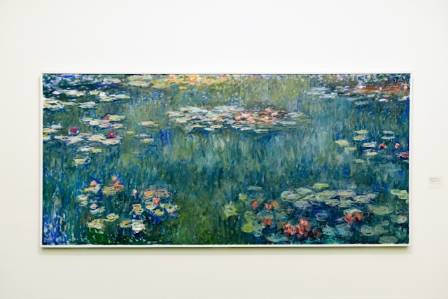
Nymphéas (1897–1898)
Among the earliest paintings featuring water lilies was Nymphéas, created between 1897 and 1898. This work established many of the themes Monet would continue exploring for decades.
Unlike many of his early compositions, it employs a horizontal format and concentrates primarily on floating lilies and their mirrored reflections on the water’s surface.
Today, the painting is housed in the Los Angeles County Museum of Art.
The Water-Lily Pond (1899)
In 1899, Monet began a sequence of eighteen paintings centered on the wooden bridge crossing his pond.
This version presents a balanced composition featuring the bridge, aquatic plants, and surrounding vegetation. A defined horizon line organizes the scene, although later works would gradually abandon such traditional spatial structures.
The painting belongs to the collection of the Metropolitan Museum of Art.
The Water-Lily Pond (1900)
Created the following year, this painting forms part of Monet’s earliest focused exploration of the water garden.
The Japanese bridge appears again, surrounded by cascading wisteria that Monet had personally planted. Although the original bridge was constructed by a local craftsman, later restoration efforts required it to be rebuilt.
This work is now part of the Museum of Fine Arts, Boston.
Water Lilies (1906)
Painted in 1906, this canvas belongs to the second major Water Lilies series completed three years later.
The painting demonstrates Monet’s growing fascination with the pond’s surface itself. Rather than emphasizing physical space, he concentrated on reflections of trees and sky floating across the water.
In 1908, Monet wrote:“These landscapes of water and reflection have become an obsession.”
His words reveal the intensity of his commitment to this subject and the countless revisions he undertook in pursuit of his vision.
The painting is currently held by the Art Institute of Chicago.
Water-Lilies, Setting Sun (c. 1907)
This remarkable painting captures the golden and pink reflections of sunset shimmering across the pond.
The composition includes drifting lilies and the reflected branches of a weeping willow. Interestingly, Monet retained the painting in his studio until 1923 before selling it to a dealer. At the time, he was preparing for cataract surgery and wished to continue studying the work, perhaps intending to revisit it after his eyesight improved.
The painting is now in the National Gallery collection.
Nymphéas (1914–1917)
Following the death of his wife Alice in 1911, Monet temporarily stepped away from his water lily project.
When he resumed painting several years later, his style had evolved significantly. The canvases became much larger, the color palette shifted, and flowers were highlighted with vibrant accents.
These innovations impressed leading artists of the period, including Paul Cézanne and Henri Matisse.
This version of Nymphéas is housed in the National Gallery of Australia.
Water Lilies (1914–1917)
In 1914, French Prime Minister Georges Clemenceau, a devoted admirer of Monet, encouraged him to undertake an ambitious decorative project.
The initiative eventually became an official state commission in 1916. This painting belongs to a series of monumental panels intended to be displayed together as a unified environment.
The work is part of the Chichu Art Museum collection.
Water Lilies in Giverny (1917)
Completed in 1917, this large canvas presents the artist’s beloved garden under brilliant sunlight.
Rich orange and yellow tones suggest the brightest hours of the day, creating a radiant atmosphere across the pond’s surface.
The painting is preserved at the Nantes Museum of Arts.
The Water Lily Pond (1917–1919)
This later work demonstrates Monet’s enduring fascination with the pond motif.
Even though he repeatedly explored the same subject, he remained unsatisfied and frequently returned to individual canvases, modifying and refining them over time.
The painting is currently part of the Albertina Museum collection.
The Japanese Footbridge (1920–1922)
Painted only a few years before his death, The Japanese Footbridge revisits the bridge theme first explored in 1899.
By this stage, Monet’s vision had deteriorated because of cataracts, yet he continued working relentlessly. The resulting paintings feature broader brushstrokes, warmer tones such as rust, orange, and maroon, and a greater degree of abstraction.
Forms become simplified, and composition is reduced to essential elements. In 1923, Monet underwent three corrective procedures on his right eye, but even before surgery, his late works demonstrated remarkable creativity and innovation.
These final paintings reveal an artist still pushing the boundaries of visual expression, helping pave the way for abstraction and modern art.
यह भी पढ़ें

Iconic classic cars of all time
Daniel Hayes
विदेशी प्रभावों से प्रेरित असाधारण इमारतें
प्रफुल्ल
Secrets to Growing Vibrant Gardenias at Home
Paul Andrew Harris

Best Vintage Sports Cars Before You Buy
Ellis Gray
झानकियाओ पियर – किंगदाओ ओल्ड टाउन
दिव्या
चाँद पर हमारे पहले पदचिह्न बनाए हुए 47 साल हो गए हैं — यहाँ वह बातें हैं जो आप पृथ्वी के धूल भरे साथी के बारे में नहीं जानते होंगे
सिद्धार्थ