← मुखपृष्ठ9 मिनट का पाठ
विशेष लेख
Why Are Flamingos Pink? 10 Fascinating Facts About These Iconic Birds
Flamingos are among the most instantly recognizable birds on the planet, celebrated for their vivid pink plumage, long stilt-like legs, and graceful curved necks. Beyond their striking appearance, these avian wonders boast a range of unusual behaviors, physiological adaptations, and ecological traits that set them apart from other birds. From their mud-built nests to their upside-down feeding habits, flamingos continue to captivate scientists and wildlife enthusiasts alike. Below are 10 fun and surprising facts that reveal the complexity and charm of these delightful creatures.
S
Sophia
लेखक
लेख परिचय
नीचे पूरा लेख पढ़ें।
अनुभाग
समाचार
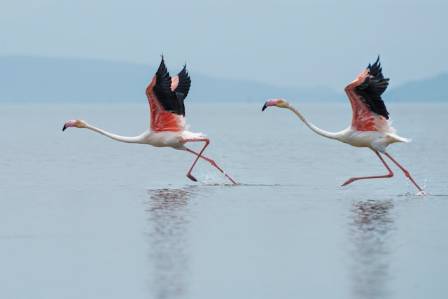
Flamingos are among the most instantly recognizable birds on the planet, celebrated for their vivid pink plumage, long stilt-like legs, and graceful curved necks. Beyond their striking appearance, these avian wonders boast a range of unusual behaviors, physiological adaptations, and ecological traits that set them apart from other birds. From their mud-built nests to their upside-down feeding habits, flamingos continue to captivate scientists and wildlife enthusiasts alike. Below are 10 fun and surprising facts that reveal the complexity and charm of these delightful creatures.
Flamingo Nests Are Mini Mud Volcanoes
Flamingos are master builders when it comes to their nests, which are uniquely constructed from mud, stones, and plant material, shaped into small, cone-like structures resembling mini mud volcanoes. Each nest is designed to hold just one large, chalky-white egg, elevated several inches off the ground to protect it from flooding and predators. These birds are monogamous, forming long-term pair bonds, and both parents play an equal role in nest construction and incubation—taking turns sitting on the egg for about 28 to 32 days until it hatches. Flamingo chicks emerge with soft, white-gray downy feathers and straight, stubby bills, lacking the iconic pink color and curved beak of adults. It takes three to five years for young flamingos to fully develop their signature pink plumage and specialized bill structure, during which time they rely on their parents for food and protection. Notably, the Smithsonian’s National Zoo has been a haven for flamingos for over 130 years, with its Bird House keepers successfully breeding more than 120 chicks since the early 1990s, contributing to conservation efforts for these beloved birds.
Flamingos Get Their Pink Color From Their Diet
The old adage “you are what you eat” couldn’t be more true for flamingos—their vibrant pink, salmon, or coral hue is entirely derived from the carotenoid pigments in their food. Carotenoids are natural compounds found in a variety of plants and algae, responsible for the orange color of carrots, the red of ripe tomatoes, and the pink of watermelon. For flamingos, the primary source of these pigments comes from their diet of microscopic algae, brine shrimp, and small crustaceans that feed on algae. When a flamingo consumes these organisms, its digestive system breaks down the carotenoids, which are then absorbed into the bloodstream and deposited in its feathers, skin, and even egg yolks. The intensity of a flamingo’s color depends on the concentration of carotenoids in its diet: birds with access to rich sources of these pigments will have brighter pink feathers, while those in nutrient-poor environments may appear pale pink or even white. This coloration isn’t just for show—it also signals health and vitality to potential mates, making it a key factor in breeding success.
Flamingos Are Filter Feeders That Eat Upside Down
Flamingos are unique among birds as specialized filter feeders, using a highly adapted bill to sift food from water. Unlike baleen whales or oysters, which use different structures for filtering, flamingos have evolved a bill with comb-like plates called lamellae along the edges, which act as a sieve. To feed, a flamingo will lower its head into shallow water and flip it upside down, pointing its bill toward its feet—a posture that seems counterintuitive but allows it to efficiently scoop up water and sediment. It then uses its tongue to pump water in and out of its bill rapidly (up to four times per second), while the lamellae trap small food particles such as algae, tiny seeds, brine shrimp, fly larvae, and other aquatic invertebrates. The water is expelled through the sides of the bill, leaving the food behind to be swallowed. This upside-down feeding method is so effective that flamingos can filter up to 20 liters of water per hour to find their next meal. Additionally, flamingos use water for thermoregulation: in warm climates, standing in water helps them cool down, while zoos like the Smithsonian’s National Zoo heat their flamingo pools to 70 degrees Fahrenheit (21 degrees Celsius) in winter, allowing the birds to stay comfortable even in snowy conditions.
A Group of Flamingos Is Called a “Flamboyance”
Few collective nouns are as fitting as the term for a group of flamingos: a “flamboyance.” This word perfectly captures the birds’ vibrant color and elegant presence, though other terms like “stand,” “colony,” or “pat” are also used. Flamingos are highly social animals, often gathering in large flocks that can number in the thousands or even millions in the wild. These large groups serve multiple purposes: they provide protection from predators (safety in numbers), facilitate mating opportunities, and help flamingos locate food sources. At the Smithsonian’s National Zoo, over 60 Caribbean flamingos (also known as American flamingos) are cared for behind the scenes at the historic Bird House. In their natural habitats, Caribbean flamingos are found in the Bahamas, Cuba, Mexico, the Southern Caribbean, and a small population of 400-500 individuals in the Galápagos Islands, with scientists estimating a total wild population of over 200,000. These flocks create breathtaking spectacles, their pink plumage contrasting vividly against the blue of water or green of grasslands.
There Are Six Distinct Flamingo Species
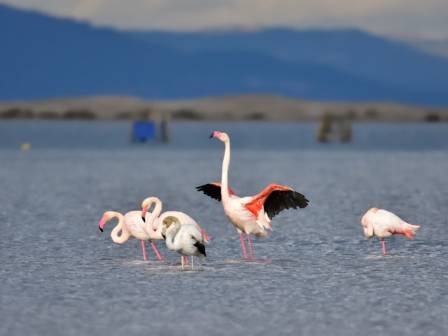
While all flamingos share core characteristics, there are six distinct species, each with unique traits, distributions, and conservation statuses. The Caribbean flamingo (Phoenicopterus ruber ruber) is the most well-known, found in the Americas, with bright pink feathers and a distinctive black tip on its bill. The greater flamingo (Phoenicopterus roseus) is the largest and tallest species, standing up to 1.8 meters (6 feet) tall, and is distributed across parts of Africa, Asia, Europe, and the Middle East. The lesser flamingo (Phoeniconaias minor) is the smallest and most abundant species, with over 2 million individuals worldwide, inhabiting parts of Africa and southern Asia—its pale pink plumage and bright red bill make it easily recognizable. In South America, three species can be found: the Chilean flamingo (Phoenicopterus chilensis), with gray legs and a pink-and-black bill; the Andean flamingo (Phoenicoparrus andinus), the rarest of the six, with fewer than 40,000 birds remaining, distinguished by its yellow legs and black-tipped pink bill; and James’s (or Puna) flamingo (Phoenicoparrus jamesi), a small species with a bright red bill and yellow legs, also native to the Andes. Each species has adapted to specific habitats, from coastal lagoons to high-altitude alkaline lakes, reflecting the group’s remarkable ecological flexibility.
Flamingos’ Knees Don’t Bend Backward—It’s an Illusion
One of the most common misconceptions about flamingos is that their knees bend backward. In reality, flamingo legs bend just like human legs—what appears to be a “knee” is actually their ankle joint. A flamingo’s true knees are located higher up its legs, hidden beneath its feathers and body, similar to how a human’s knee is positioned. To understand this, imagine a flamingo standing on its tiptoes: the long, lower part of its leg is equivalent to a human’s foot, and the joint that bends when the bird sits or steps is the ankle. This unique leg structure is an adaptation for wading in shallow water, allowing flamingos to reach deep into water while keeping their bodies upright. Their legs are also equipped with scaly skin that protects them from sharp objects and corrosive water, and their webbed feet help them balance on soft mud and swim efficiently when needed. This anatomical quirk adds to the flamingo’s exotic appeal, making it a favorite subject of curiosity for animal lovers.
Some Flamingos Thrive in Extreme Alkaline Lakes
Flamingos are surprisingly resilient, with some species adapting to live in some of the harshest environments on Earth: alkaline (or “soda”) lakes. These lakes are characterized by extremely high concentrations of carbonate salts, making the water so corrosive that it can burn human skin and is uninhabitable for most other animals. Yet species like the lesser flamingo and Andean flamingo breed and raise their young in these lakes, drawn to the abundant supply of algae and brine shrimp that thrive in the extreme conditions. Flamingos have evolved unique physiological adaptations to survive here, including tough, scaly leg skin that resists corrosion and specialized kidneys that filter out excess salt. However, these environments still pose risks—young flamingo chicks are particularly vulnerable, as salt can build up on their legs, forming crusty rings that restrict movement and may even lead to death if not removed. Researchers continue to study how flamingos tolerate such extreme conditions, hoping to uncover more about their remarkable resilience and adaptability.
Flamingo Parents Feed Their Chicks “Crop Milk”
Flamingo parents have a unique way of feeding their young: they produce a nutrient-rich liquid called “crop milk” (or “pigeon milk,” though it’s not related to dairy milk) in a specialized part of their throat called the crop. This milky substance is thick, high in proteins, fats, and carotenoids, and is regurgitated by both parents to feed their chick for the first few months of life. Unlike mammalian milk, crop milk is produced by cells lining the crop, not mammary glands, and is pink or orange in color due to the carotenoids it contains. This diet is crucial for the chick’s growth and development, providing all the nutrients it needs until its bill is fully developed enough to filter food on its own. Flamingo chicks feed by inserting their bills into their parents’ mouths to access the crop milk, a behavior that strengthens the bond between parent and offspring. Both male and female flamingos can produce crop milk, ensuring that the chick receives consistent care and nutrition from both parents.
Flamingos Are Skilled Flyers (Despite Their Appearance)
Many people associate flamingos with standing still in water or wading slowly through lagoons, but these birds are actually strong, capable flyers. Flamingos have long, broad wings that span up to 1.5 meters (5 feet) across, and their hollow bones and lightweight bodies make them well-adapted for flight. They typically fly in large V-shaped formations, similar to geese, which helps conserve energy during long journeys. Flamingos take flight for several reasons: to migrate between breeding and feeding grounds, to escape harsh weather conditions (moving to warmer, lower-altitude areas in winter), or to find new water sources as seasons change. When traveling long distances, flamingos often fly at night to avoid predators and take advantage of cooler temperatures. Before taking flight, they perform a distinctive “wing-stretching” ritual to warm up their muscles, flapping their wings vigorously and running a few steps on water to gain lift. Once airborne, they can reach speeds of up to 55 kilometers (34 miles) per hour and travel hundreds of kilometers in a single day.
Flamingos Sleep Standing on One Leg
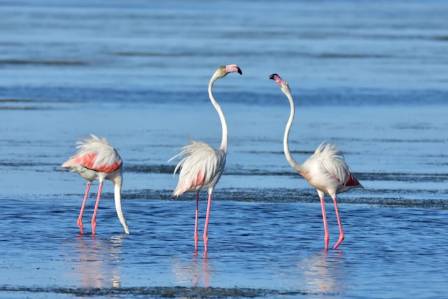
One of the most intriguing behaviors of flamingos is their ability to stand on one leg for hours at a time—even while sleeping. This seemingly gravity-defying feat has puzzled scientists for years, but recent research has uncovered two key reasons behind it. First, standing on one leg requires less muscle effort than standing on two. Studies have shown that flamingos can lock their leg joints in place, allowing them to rest without expending energy to balance, reducing fatigue during long periods of standing. Second, this posture helps them conserve body heat. Birds lose a significant amount of heat through their limbs, and by tucking one leg up under their belly, flamingos minimize the surface area exposed to the cold, retaining more body heat—especially useful in cool or windy environments. Interestingly, flamingos can switch legs periodically to avoid numbness, and they often sleep with their heads tucked under their wings, creating a cozy, compact posture. This unique adaptation perfectly illustrates how flamingos have evolved to thrive in their environments, combining efficiency and comfort in one elegant pose.
यह भी पढ़ें

hi
मुआय थाई बनाम ब्राज़ीलियन जिउ-जित्सु
आशा

hi
हमारे समाज में घोड़ों की बदलती भूमिका
एकता
en
Simple Homemade Strawberry Daifuku: A Guide to the Perfect Japanese Treat
Colton Hayes

hi
समुद्र की चमकती मुस्कान
एमिली हार्टवेल

en
Best Homemade Lemonade Ever
Aurora Vale

hi
दुनिया की सबसे खूबसूरत लोमड़ियों की 7 प्रजातियाँ
दिव्या