विशेष लेख
Finding Out the Global Population of White Rhinos
On July 22, 2025, the world said goodbye to Ozzy, a legendary American rock star. Coincidentally, on the very same day, a new white rhino entered the world—also named Ozzy! The Safari West wildlife preserve, located in Santa Rosa, California, gave the newborn calf this name to honor the recently deceased singer, whose passing had been announced just a few hours before the rhino’s birth. The calf’s mother, Eesha, a 20-year-old southern white rhino, and father, Ongava, are reported to be forming a strong bond with their new baby. Staff at the wildlife preserve explain that the name not only pays tribute to Ozzy Osbourne but also symbolizes the endless cycle of life.
Natalie Foster
लेखक
लेख परिचय
नीचे पूरा लेख पढ़ें।
अनुभाग
समाचार
On July 22, 2025, the world said goodbye to Ozzy, a legendary American rock star. Coincidentally, on the very same day, a new white rhino entered the world—also named Ozzy! The Safari West wildlife preserve, located in Santa Rosa, California, gave the newborn calf this name to honor the recently deceased singer, whose passing had been announced just a few hours before the rhino’s birth. The calf’s mother, Eesha, a 20-year-old southern white rhino, and father, Ongava, are reported to be forming a strong bond with their new baby. Staff at the wildlife preserve explain that the name not only pays tribute to Ozzy Osbourne but also symbolizes the endless cycle of life.
If you’ve ever encountered a white rhino in the wild, you know how imposing they can be. Their huge bodies, thick heads, and powerful horns all showcase their majestic strength. Yet, the future of these magnificent creatures is far from certain. Keep reading to learn more about the specific threats that these stunning animals are up against.
What is a White Rhino?
White rhinos are a species within the rhinoceros family, Rhinocerotidae, and their scientific name is Ceratotherium simum. In Greek, this name refers to both the rhinos’ horns and their flat noses. Despite being called “white rhinos,” these animals are actually gray. This mix-up comes from a simple misunderstanding: Dutch settlers originally called these rhinos “weit,” a term that means “wide” in Afrikaans, but English settlers misheard it as “white.” Even though the name is inaccurate, it stuck over time.
Today, there are five distinct rhino species in the world: the white rhino, black rhino, Indian rhino, Javan rhino, and Sumatran rhino. The white and black rhinos live in Africa, while the Indian, Javan, and Sumatran rhinos are found in Asia.
About White Rhinos
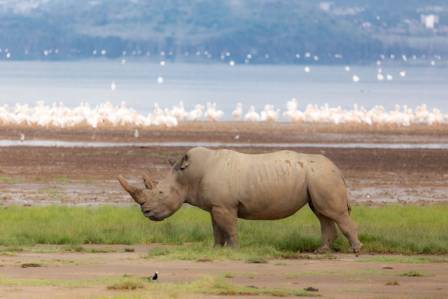
White rhinos are the largest of all rhino species. They are also the second-largest land animal, coming in only after the African bush elephant. An adult white rhino can weigh around 5,000 pounds, and adult males can grow up to 13 feet long. Their heads are so heavy that they need a hump of muscle on their shoulders to support the weight. White rhinos have two horns—one large and one small—and relatively big ears. Their mouths are wide and square, which sets them apart from black rhinos, who have triangular mouths.
You might not expect it given their size, but white rhinos are surprisingly fast. At their top speed, they can run over 30 miles per hour. Unfortunately, they can become aggressive when defending their territory, and their quick acceleration means that anything they target might not have enough time to get out of the way.
While white rhinos are usually calm when they don’t feel threatened, males can be extremely territorial. They will charge at anything they see as a danger. White rhinos have sharp hearing and a strong sense of smell, but their eyesight is famously poor. This sometimes causes them to charge at animals or objects that don’t actually pose a threat.
Mother white rhinos with calves are just as dangerous as males—if not more so. These females will charge if they think their babies are in danger. Contrary to what many people believe, rhinos use their lower incisors more than their horns to harm other animals.
Even though they look intimidating, white rhinos are herbivores. They graze on the open savannas of Africa, eating more than 120 pounds of grass every day.
How Many White Rhinos Are Left in the World?
Currently, there are roughly 17,464 white rhinos remaining worldwide. While this number is still lower than what conservationists hope for, it’s a huge improvement compared to the population levels in the past.
There are two subspecies of white rhinos: the northern white rhino and the southern white rhino.
Northern White Rhino
There are only two known northern white rhinos left in the world, and both are female. This means the subspecies is functionally extinct—unable to reproduce naturally. The two females are named Najin and Fatu. The last male northern white rhino died in 2018 due to health issues. Even if there were a viable male left, both Najin and Fatu would not be able to have offspring. They are under constant 24/7 guard at the Ol Pejeta Conservancy in Kenya.
Southern White Rhino
Southern white rhinos are found in just four African countries: South Africa, Namibia, Zimbabwe, and Kenya. Nearly all rhinos living in Africa belong to this southern subspecies.
Before 1895, people thought southern white rhinos were extinct. Then, a group of around 100 southern white rhinos was discovered in South Africa. With careful conservation efforts, this small group grew into the population we see today.
White Rhino Predators and Lifespan
Can an animal as large as a rhino have predators? The answer depends on how old the rhino is. White rhinos don’t have many predators, but young white rhinos (adolescents) need to watch out for big cats like lions and cheetahs. They also face threats from crocodiles, hyenas, and wild dogs.
Once white rhinos reach their full adult size, these animals rarely—if ever—bother them. However, humans are the biggest threat to white rhinos, as they are frequently hunted by poachers.
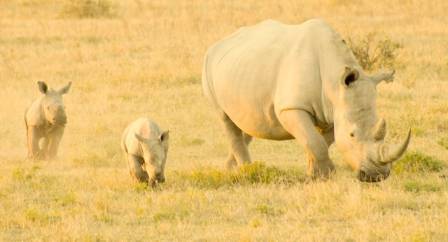
In the wild, white rhinos can live up to 50 years. But they have a very long gestation period—up to 500 days—and after giving birth, females typically don’t have another calf for 3 to 4 years. This slow reproductive rate makes it hard for white rhino populations to recover quickly.
Are White Rhinos Endangered?
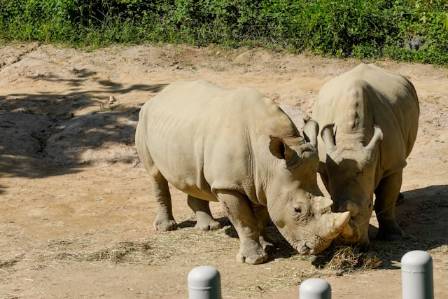
The International Union for Conservation of Nature (IUCN) classifies white rhinos as “Near Threatened.” It’s important to note that this classification applies to the white rhino species as a whole, not to the northern subspecies, which is already functionally extinct.
White rhinos have been fighting against extinction for over a hundred years, mainly because of poaching. Their horns are highly valuable—sought after for use in traditional Chinese medicine and as prized hunting trophies. This demand is a big reason why only two northern white rhinos remain today.
A complex effort to save the northern white rhino is currently underway. Led by Dr. Cesare Galli in Italy, a team of scientists is working to fertilize eggs from the two remaining northern white rhinos, Najin and Fatu. For years, scientists collected sperm from the last remaining male northern white rhinos, including Suni and Sudan—the final two males that died. Collecting both sperm and eggs is an extremely delicate process, but with great care, the team has successfully obtained both.
The plan is to create baby northern white rhinos using in vitro fertilization (IVF). But even if IVF is successful, the embryos will need a surrogate mother. Neither Najin nor Fatu is suitable for this role, so scientists are looking to female southern white rhinos to act as surrogates. In theory, with medical intervention, northern white rhino calves could be born in the next few years.
However, this outcome is not guaranteed. The IVF process for rhinos is famously complex and uncertain. What’s more, some conservationists argue that humans should let the northern white rhino go extinct. They point out that the large amounts of money needed to keep this subspecies alive through artificial means could be better used to protect other rhino species that have a better chance of survival. Additionally, they worry that with such a small genetic pool, any northern white rhinos born through IVF would not be healthy or genetically diverse enough to survive on their own.
While white rhinos still aren’t out of danger, it’s encouraging to know that their chances of survival are better now than they have been in the past hundred years.
Conclusion
The story of white rhinos is one of both struggle and hope. From being mistaken for “white” due to a linguistic mix-up to facing the brink of extinction from poaching, these majestic creatures have endured countless challenges. Today, while the northern subspecies is functionally extinct, the southern white rhino has made a remarkable comeback thanks to dedicated conservation work. The roughly 17,464 white rhinos worldwide are a testament to what can be achieved when we prioritize protecting wildlife. Still, threats like poaching and slow reproduction rates mean we can’t let our guard down. Whether it’s through guarding remaining rhinos, supporting scientific efforts to save the northern subspecies, or investing in broader rhino conservation, every step matters. By continuing these efforts, we can help ensure that white rhinos continue to roam the African savannas for generations to come.
यह भी पढ़ें

तिरामिसू का अनावरण: इटली के इस प्रतिष्ठित कॉफी डेज़र्ट के बारे में रोचक जानकारी
साहिल खुराना

Trams: A Modern Answer to Sustainable Urban Transport
Hannah Louise Scott

मुख्य आँकड़े
प्रणव

रोसी से लेकर रूंबा तक, स्वायत्त रोबोट विज्ञान कथा को जीवन में लाते हैं
अनया

16 Unique Ways Ice Cream Is Enjoyed Around the World
Amelia

7 अविश्वसनीय गंतव्य यदि आपको शांति और विश्राम की आवश्यकता है
एंड्रिया रोमानो