विशेष लेख
Brooklyn Bridge: New York City's Historic Engineering Icon
The Brooklyn Bridge is one of New York City’s most famous landmarks and a remarkable achievement in nineteenth-century engineering. Spanning the East River, it connects the boroughs of Manhattan and Brooklyn and remains one of the city's most recognizable structures.
Clara Ann Young
लेखक
लेख परिचय
नीचे पूरा लेख पढ़ें।
अनुभाग
समाचार
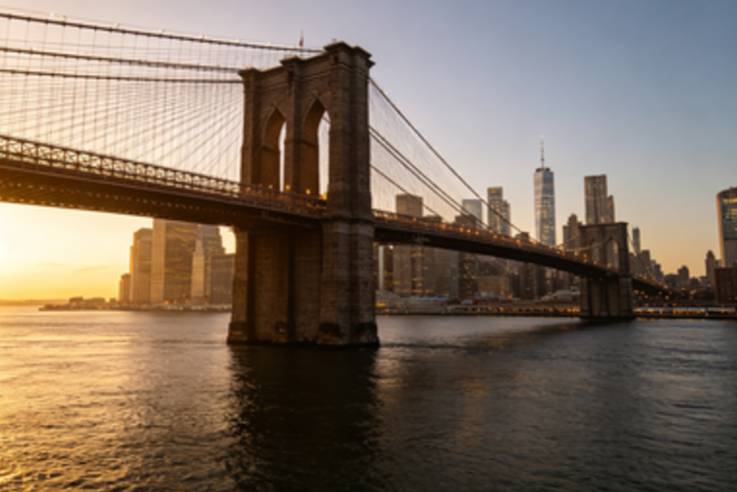
The Brooklyn Bridge is one of New York City’s most famous landmarks and a remarkable achievement in nineteenth-century engineering. Spanning the East River, it connects the boroughs of Manhattan and Brooklyn and remains one of the city's most recognizable structures.
Officially opened on May 24, 1883, the bridge became the first permanent crossing over the East River. At the time of its completion, it was the longest suspension bridge in the world, featuring a main span of approximately 486 meters (1,595 feet) and rising nearly 39 meters (127 feet) above the water. Originally known as the New York and Brooklyn Bridge or the East River Bridge, it officially adopted the name Brooklyn Bridge in 1915.
The concept of linking Manhattan and Brooklyn by bridge had been discussed since the early nineteenth century. The project eventually took shape under the vision of engineer John A. Roebling, whose innovative design combined suspension and cable-supported elements. After Roebling’s death, his son, Washington Roebling, assumed responsibility for the project and continued its development. He was supported by his wife, Emily Warren Roebling, whose contributions played a crucial role in the successful completion of the bridge.
Construction began in 1870 under the supervision of the New York Bridge Company. The project faced numerous technical challenges, political disputes, and engineering uncertainties, all of which extended the construction period to more than thirteen years. Nevertheless, the completed bridge quickly became a symbol of progress and innovation.
Throughout its history, the Brooklyn Bridge has adapted to changing transportation needs. In its early years, it accommodated horse-drawn carriages, pedestrians, and railway traffic. As New York City's population and traffic volumes increased, additional bridges and tunnels were built across the East River to supplement its capacity. Over time, the bridge underwent several major renovation and preservation projects, including extensive restoration work during the twentieth and twenty-first centuries.
Today, the Brooklyn Bridge is the southernmost of the five major vehicular crossings linking Manhattan and Long Island. To its north are the Manhattan Bridge, Williamsburg Bridge, Queensboro Bridge, and the Robert F. Kennedy Bridge. The bridge currently serves passenger vehicles as well as dedicated pedestrian and bicycle pathways, making it both a vital transportation route and a popular recreational destination.
Since its opening, the Brooklyn Bridge has attracted millions of visitors from around the world. Its distinctive Gothic-style stone towers and sweeping network of steel cables have made it an enduring symbol of New York City. The bridge has appeared in countless films, photographs, and works of art, while also serving as the setting for public events, performances, and historic moments.
Recognized for its architectural and engineering significance, the Brooklyn Bridge has received several prestigious designations, including National Historic Landmark status, New York City landmark protection, and recognition as a National Historic Civil Engineering Landmark. More than a century after its completion, it continues to stand as one of the greatest engineering achievements in American history and an enduring icon of New York.
यह भी पढ़ें
Guédelon Castle: Building a Medieval Fortress Through Experimental Archaeology
Elias

दुनिया के 3 सबसे स्वप्निल मैकरॉन (हां, वे इतने अच्छे हैं)
प्रिया

समुद्र के शांतिपूर्ण कैनवास
एलेना मॉरिसन

ब्लैक-चीक्ड लवबर्ड
सुमित

हमारे संपादकों के शुरुआती स्कियर्स के लिए शीर्ष 10 टिप्स
आदिति

Top 5 Stargazing Destinations on the East Coast
Ava Thomas